





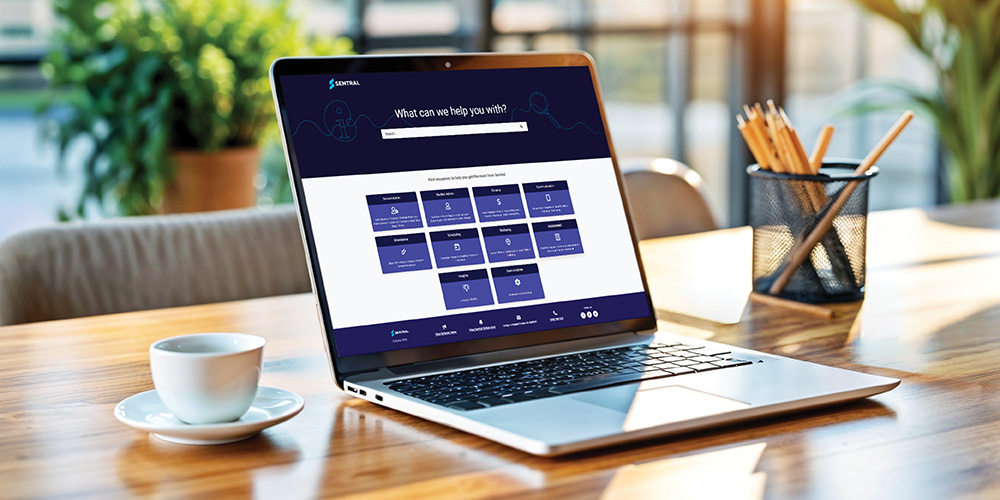
Introducing the new Sentral Help Centre: faster, simpler support when you need it.
A better support experience, built with user feedback.
4 min read

For independent schools, finance is not merely a back-office function. It’s central to enrolment, parent experience, and cash flow.
In many schools, finance processes still rely on spreadsheets, legacy tools, and disconnected systems.
Most schools, according to Sentral Product Manager James MacDonald, “expect their systems to alleviate their workload, not add to it.” They seek a solution that’s simple, consistent, and dependable: “something that just works.”
The real question is not “one platform or many?” but rather which components of the enrolment to payment journey must reside in your SIS, and where should you intentionally integrate specialised finance tools like Xero or Microsoft Business Central?
MacDonald identifies a workflow that cannot tolerate friction: enrolments → debtor creation → billing → invoicing → collecting payments → debtor management. This is the critical workflow. When this chain spans multiple products, reconciliation points can multiply and erode trust.
“If that flow of information is within one system,” he says, “it’s clean, consistent, and far less prone to errors. There are no handoffs between systems, no reconciliation points.”
So, MacDonald recommends that the first design decision should be to maintain the operational control of this workflow within your SIS, where live student and family data sits.
Meanwhile, St Gregory’s College Director of Business Operations Brian Schick describes the billing succinctly.
“All the information we need for fees and billing is inside the student information system,” he says.
“Are the parents together or separated? Is grandma paying the school fees? What year is the child in? Do they have siblings? Are they on a scholarship? Do they have a bursary?”
That complexity does not exist natively in an accounting package; it lives in the SIS.
If you push billing into a separate finance tool, you must export and constantly re‑sync all these variables as students join, leave, or change status throughout the year.
“If you’re going to use a different product to create all the bills,” Schick argues, “you’ve got to transfer all that information into that other product and ensure it remains current.”
St Gregory’s College is an independent Catholic boys’ day and boarding school in Gregory Hills, southwest Sydney, with about 1,100 students across co‑educational primary and boys’ secondary on a single campus.
At St Gregory’s, the decision was made to use Sentral as the “point of truth” for enrolments and billing, connecting it to a modern accounting stack via APIs.
This represents the best‑of‑both‑worlds approach: the SIS owns the enrolment‑to‑payment workflow, while specialised finance tools manage the general ledger, reporting, and approvals.
Keeping billing in the SIS does not mean sacrificing control. Sentral’s fee tables and flags allow St Gregory’s to automate sibling discounts, scholarships, and bursaries, resulting in a billing process that “goes pretty quickly”.
However, Schick emphasises that this automation must be auditable.
“Our auditors want us to demonstrate how we verify that what Sentral has done is correct,” he says. His team runs a dummy billing for each fee, compares it to an Excel model of expected totals, takes screenshots for documentation, and retains that evidence before executing the live billing, which then takes only minutes.
This establishes a governance pattern: the SIS handles complex fee logic and mass billing, while finance retains responsibility for verification, documentation, and audit assurance.
None of this suggests that your SIS should replace a comprehensive accounting system. Both MacDonald and Schick strongly advocate against that.
“There are systems out there… that handle the grunt work associated with the general ledger and reporting,” MacDonald says.
“When you have your billing, enrolments, finance, debtor management, and parent payments in one system, and then hand off to an accounting package, the school benefits from the best of both worlds.”
Schick has experienced the alternative.
In a previous all-in-one platform, he “couldn’t even print out a balance sheet and a profit and loss,” because the product was “trying to be all things to all people.”
Today, at St Gregory’s, Sentral manages enrolments, fees, billing, and debtor control, while Xero anchors the accounting stack – covering 54 budgets, payroll, purchase approvals, and banking feeds.
“It all just works really well,” he says, “because it’s all industry-leading, and all the APIs just work.”
Cloud accounting and automation specialist Luis Sanchez calls this a “unified ecosystem of apps, of best-of-breed solutions” that enhance operational efficiency, drive financial clarity, and improve accountability. His perspective: accounting packages like Xero or Microsoft Business Central are ideally suited for general ledger management, reporting and increasingly AI-driven insights, while systems like Sentral provide clean, trusted operational data.

The enrolment to payment workflow does not end when invoices are issued; how parents pay is equally critical.
After transitioning to an earlier version of Sentral Pay, St Gregory’s required parents to log in and set up a payment schedule for every invoice covering hundreds of sundry items. “It was a nightmare,” Schick recalls. “We lost control of our debtors.”
Collaborating with Sentral, they flipped that design.
Now, parents log into the same portal where they can view student information, select their payment method (card or bank account) and choose a payment schedule – weekly, fortnightly, monthly, termly or annually.
“That’s a set and forget,” Schick says. “When we run the bill… we instruct it to use those preferences, and it processes automatically.”
Parents can see all their invoices and bills, pay within the app, and modify their direct debit preferences all in one place. For the school, this has transformed hundreds of “$37.50” sundry invoices from manual tracking into predictable, automated collections. Schick expects “it’s going to take the whole pressure off us.”
MacDonald sums up the philosophy: “Parents are the clients of the school.” A unified, finance grade parent experience inside the SIS is not merely cosmetic; it directly supports cash flow and debtor control.
For leaders designing their next‑generation finance environment, the emerging model is:
Keep in the SIS:
Integrate to best‑of‑breed accounting for:
In other words, Sentral does not impose a “one size fits all” finance stack. It anchors the critical enrolment‑to‑payment workflow and unified parent experience, then connects cleanly to industry solutions such as Xero and Microsoft Business Central, so each school can create the right financial ecosystem for its context.
Schools do not have to choose between a single SIS and a modern accounting stack.
They can have both – a SIS that retains operational control where the data resides, and cloud accounting tools that excel in their specific functions, all interconnected in a way that, in Schick’s words, “just works”.
Brian Schick
Director of Business Operations


A better support experience, built with user feedback.

As parents and educators, we understand the importance of fostering student wellbeing that extends beyond the classroom. It's about creating a...

This article was written by Serena Stevens, Marketing Executive As a former early-career teacher, I learned the value of following up...